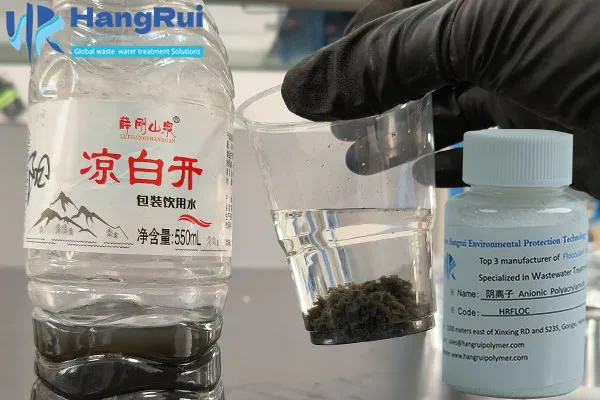
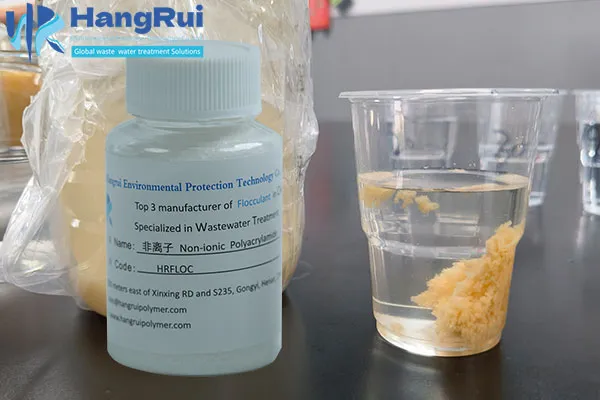
The textile printing and dyeing industry consumes vast quantities of water and generates significant volumes of wastewater. This wastewater contains pigment particles, reactive dyes, disperse dyes, acrylic binders, thickeners, and various auxiliary agents. If discharged without proper treatment, it causes severe chromatic pollution and damages aquatic ecosystems.
Coagulation-flocculation serves as an economical and effective pretreatment process for textile printing and dyeing wastewater. Among the various flocculants available, polyacrylamide (PAM) stands out due to its adjustable molecular weight, versatile charge characteristics, and low dosage requirements. PAM can be synthesized in cationic, anionic, or non-ionic forms to suit different dye systems. This article focuses on the application of PAM polymers in the purification of textile printing and dyeing wastewater, covering flocculation mechanisms, influencing factors, laboratory optimization data, advanced modified PAM variants, and detailed, real-world field application scenarios.
1. Role and Mechanism of PAM in the Treatment of Textile Printing and Dyeing Wastewater
The flocculation performance of polyacrylamide (PAM) primarily relies on charge neutralization and polymer bridging, with auxiliary contributions from processes such as adsorption and sweep flocculation.
Charge Neutralization: Most dye colloids, pigment particles, and emulsified binder droplets in printing and dyeing wastewater carry a negative surface charge, which leads to mutual repulsion and stable suspension. Cationic PAM, containing positively charged quaternary ammonium groups, can neutralize the negative charges on these colloids and weaken electrostatic repulsion, allowing fine particles to collide and form micro-flocs. This mechanism plays a dominant role in the treatment of reactive dye wastewater, which is otherwise difficult to decolorize.
Bridging Flocculation: PAM is a long-chain, water-soluble polymer. Once micro-flocs are formed, the extended polymer chains can adsorb multiple micro-flocs simultaneously, linking them together into large, dense flocs. These flocs settle rapidly under the influence of gravity or can be separated via dissolved air flotation (DAF). A high molecular weight is essential for effective bridging. In the case of disperse dye wastewater, anionic PAM is often applied following the use of polyaluminum chloride (PAC) or polyferric sulfate (PFS) to enhance the compaction of the flocs.
2.Selection and Dosage of PAM
2.1 Selection of PAM Type:
Wastewater from reactive dye printing: Cationic polyacrylamide (CPAM) with medium-to-high cationic charge density is the preferred choice, typically added after the application of polyaluminum chloride (PAC) or a decolorizing agent.
Wastewater from disperse dye or pigment printing: High-molecular-weight anionic polyacrylamide (APAM) often yields better results following inorganic coagulation.
Wastewater containing a mixture of various dyes: Amphoteric polyacrylamide (AmPAM) serves as an alternative when pH levels are unstable.
2.2 Optimization of Dosage and pH:
Insufficient dosage leads to incomplete flocculation and high residual color. Excessive dosage causes charge reversal and the restabilization of colloids, while also producing sticky flocs that can clog filter media.
For textile printing wastewater, the typical PAM dosage ranges from only 1 to 6 mg/L. Bench-scale (beaker) test results indicate that with a dosage of 200 mg/L of PAC and 3.5 mg/L of CPAM at a pH of 7–8, the decolorization rate reaches 91.2%, the removal rate of suspended solids (SS) reaches 94.6%, and the chemical oxygen demand (COD) removal rate reaches 68.3%.
| Textile printing wastewater | |||||
| PH | PAC dosage | CPAM dosage | Decolorization rate | (SS)removal rate | (COD) removal rate |
| 7~8 | 200 mg/L | 3.5 mg/L | 91.20% | 94.60% | 68.30% |
3. On-site Application Details of PAM for Textile Printing Wastewater
Textile printing wastewater is not a single homogeneous stream. It can be divided into screen washing wastewater, printing washing-off wastewater, mixed comprehensive wastewater and printing sludge. The selection of PAM, dosing points and operation habits differ greatly.
3.1 Screen and Roller Washing Wastewater
This stream comes from cleaning printing screens and rollers, with extremely high instantaneous concentration, heavy color and high surfactant content.
- PAM selection: High cationic CPAM, usually matched with special decolorant + PAC.
- Dosing point: Independent pretreatment tank before the regulating tank.
- On-site goal: Precipitate most pigments and dyes separately to avoid shocking the biochemical system.
- Operation notes: This wastewater cannot be directly mixed into the combined wastewater tank. Surfactants suppress flocculation, so separate jar tests are required.
- Common problems: Flocs are fine and float easily; excessive PAM produces sticky sludge that adheres to the pipeline.
3.2 Printing Washing-off Wastewater
Generated after fabric printing and washing, with moderate COD and chroma, relatively stable compared with screen washing wastewater.
- PAM selection: Medium cationic CPAM for reactive dye; anionic PAM for disperse pigment printing.
- Dosing point: Front of air flotation tank or sedimentation tank.
- On-site goal: Remove most suspended pigment and colloidal dyes to reduce the organic load of biochemistry.
- Operation notes: The water quality changes with fabric batches and dye formulas. Operators need to adjust dosing rate when switching fabric types.
3.3 Combined Wastewater (Pre-biochemistry / Advanced Treatment after Biochemical)
All printing wastewater converges in the regulating tank.
- Pre-biochemical treatment: Decolorant + PAC + CPAM for primary sedimentation or air flotation.
- Advanced treatment of secondary effluent: Medium-low cationic PAM for further turbidity and residual color removal, to meet discharge standards or reuse as cleaning water.
- Reuse scenario: Treated water can be used for workshop floor washing, equipment cleaning and cooling water circulation.
3.4 Textile Printing Sludge Dewatering
Textile sludge is a mixture of flocculation sludge and biological sludge, with strong viscosity.
- Belt filter press: Medium cationic CPAM; flocs must be loose and non-sticky. Sticky flocs blind filter cloth and shorten cloth service life.
- Centrifuge: High cationic CPAM to form shear-resistant flocs and prevent sludge leakage.
- Target: Control filter cake moisture at 75%–82%.
- Pain points: Residual dye and thickener increase sludge viscosity and PAM consumption. Improper dissolution creates PAM fish-eyes that clog metering pumps. Prepare 0.1%–0.2% solution, water temperature ≤40 ℃, use freshly prepared solution within 24 hours.
3.5 General On-site Operation Guidelines
- Dosing sequence: decolorant (if used) → PAC with fast mixing → PAM with slow mixing. Do not add them simultaneously.
- Jar test routine: Take fresh on-site wastewater samples when dye formula or production batch changes, test different cationicity PAM and observe floc size, settling speed, supernatant clarity and stickiness.
- Storage: Solid PAM must be stored in dry conditions. Moisture causes caking and poor solubility. Flush dosing pipelines regularly.
- Cost control: Factories with unstable water quality should set up separate collection for high-concentration screen washing wastewater to avoid overall soaring PAM consumption.

4. Conclusion

Polyacrylamide (PAM) is an indispensable polymeric flocculant in the purification of textile dyeing and printing wastewater. Depending on the type of dye and the specific characteristics of the wastewater, cationic, anionic, or amphoteric PAM can be selected. Through mechanisms such as charge neutralization and bridging flocculation, PAM enables efficient decolorization and the removal of suspended solids (SS) even at low dosage levels. Henan Hangrui Environmental Protection Technology Co., Ltd. is a professional manufacturer of polyacrylamide with 20 years of production experience. The company offers free samples and beaker testing, and can customize the most suitable water treatment agents based on the technical data provided by clients. Furthermore, the company has developed various modified PAM products specifically designed for environments containing surfactants or high salinity. As the textile dyeing and printing industry faces increasingly stringent discharge regulations and higher requirements for water reuse, customized PAM products—combined with optimized coagulation-flocculation processes—will remain the core elements for achieving stable and cost-effective treatment of dyeing and printing wastewater.